
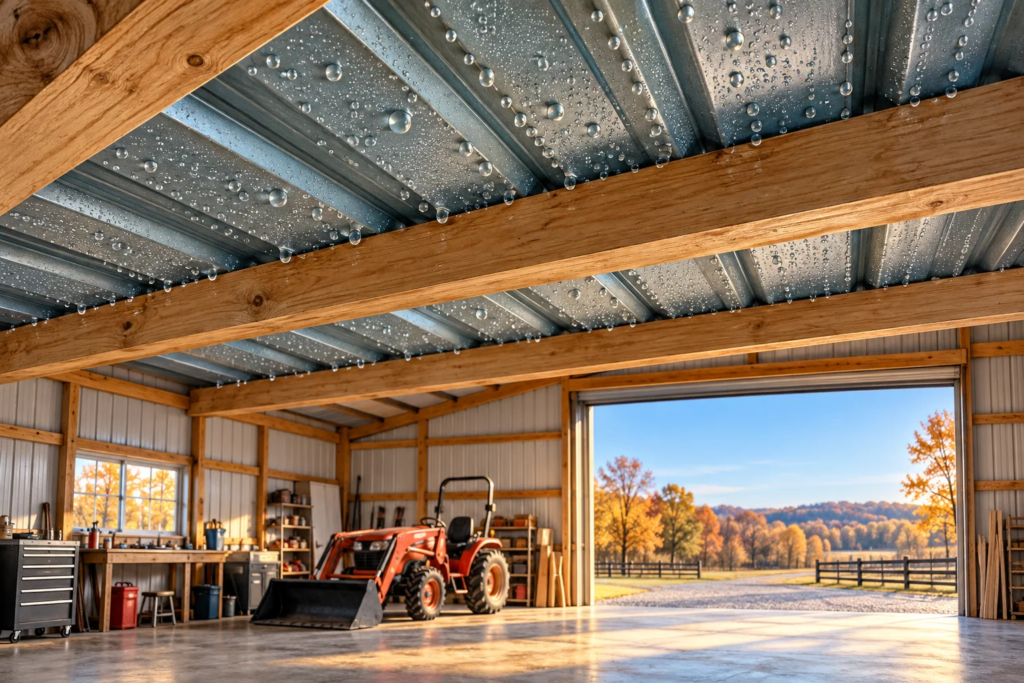
The sky is clear. The roof looks sound. Yet water is dripping onto your workbench. It is tempting to blame a loose fastener or order another coat of sealant. But in a metal building, water can form on the inside of the roof without passing through it. Understanding that difference can prevent an expensive repair that solves the wrong problem.
For a shop, garage, or farm building in Northeast Missouri, the useful first question is not simply “Where is the hole?” It is “When does the water appear, and what was happening inside the building?”
A cold surface can turn invisible moisture into visible water
Air contains water vapor. When a surface is cold enough to be below the surrounding air’s dew point, moisture can condense on it. The National Frame Building Association describes this same mechanism in post-frame buildings. A metal roof underside can therefore collect droplets even when the weather outside is dry. NFBA’s building-envelope guidance explains why surface temperature matters.
This is a possible explanation, not a diagnosis from a photograph. A roof leak and condensation can exist in the same building. A local drip might also follow framing before reaching the floor, so the wet spot below is not necessarily the source above.
Read the pattern before choosing the repair
Start a simple observation log. Photograph the same area from the floor, note the date and weather, and record whether doors were open, heat was running, or wet equipment had just come inside. You are looking for a repeatable relationship.
- Widespread droplets after a cold night: ask the reviewer to investigate condensation and the roof assembly.
- A localized wet area that follows wind-driven rain: ask for a roofing inspection, including penetrations and transitions.
- Moisture that increases after washing equipment or parking snowy vehicles: include those activities in the moisture investigation.
- Water at the wall or floor edge: include site drainage and bulk-water entry in the review rather than assuming a roof problem.
None of these clues proves the cause by itself. Their value is that they turn “my building is wet” into information a contractor can investigate.
Look at what the building is being asked to do
Consider a hypothetical equipment shed that was originally used for dry storage. Later, its owner adds heat, begins washing machinery inside, and keeps the doors closed through winter. The exterior has not changed, but the interior conditions have. A fix should account for that new use.
Potential moisture sources include exposed ground, a recently placed slab, wet vehicles, washing, and combustion equipment. EPA’s moisture-control guidance treats water entry, indoor moisture, and condensation as connected design issues. Do not use unvented combustion equipment as an improvised drying strategy; its moisture and combustion products create additional concerns.
Insulation, air sealing, and vapor control have different jobs
Insulation changes heat flow. Air sealing limits air movement through unintended gaps. Vapor-control layers manage moisture diffusion through an assembly. Ventilation exchanges air. These measures must work together; one product is not a universal replacement for all four.
Adding a liner or insulation without understanding the existing roof can conceal moisture or reduce an assembly’s ability to dry. Likewise, “more vents” is not a complete specification. Climate, heating schedule, roof configuration, and indoor activities all matter. Building America’s condensation guide shows why temperature and moisture control need coordinated planning.
Bring a useful problem description to the conversation
Gather exterior and interior photographs, the building’s approximate age, the present roof and wall layers if known, and your observation log. Describe whether the space is unheated storage, a daily heated shop, or something in between. Mention any planned changes before a repair is scoped.
The goal is a building that stays suitable for its actual use, with a repair you can understand. Explore our shop-building planning information or send Bontrager Builders your project details. We serve Anabel, Canton, and surrounding Northeast Missouri communities and offer free estimates for proposed work.
Custom AI-generated editorial illustration; a planning concept, not a photograph of a completed Bontrager Builders project.