
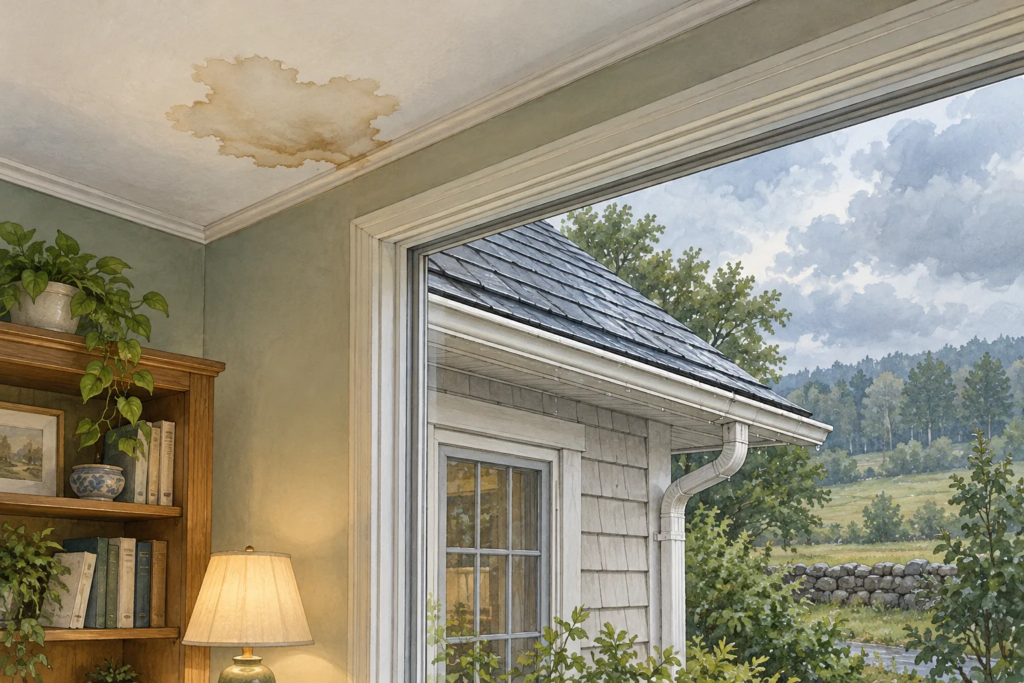
The brown mark on your ceiling tells you where water became visible—not necessarily where it entered. That is why a quick look from the driveway cannot always answer whether the roof needs a small repair, a larger intervention, or a different kind of investigation.
Before spending money on a solution, build a useful description of the problem. Good observations help the appropriate professional investigate the source instead of treating the stain as the whole story.
Record the first event while you still remember it
Write down when you noticed the mark, whether it was wet, and what the weather had been doing. Did it appear during steady rain, after wind, during snowmelt, or when the weather was dry? Note any recent plumbing, HVAC, roofing, or exterior work nearby.
Photograph the whole room corner as well as the mark itself. Include a fixed reference such as a window or wall so the location can be understood later. If you can safely do so from the floor, repeat the photograph from the same position when conditions change. Do not paint over an active problem before it has been assessed.
A hypothetical example makes the value clear: “The stain returned during the first west-driven rain after the repair” gives the reviewer more to work with than “the ceiling is still bad.” The observation suggests a condition to investigate; it does not prove a specific defect.
Keep more than one possible source in view
Roof water can travel along building components before appearing indoors. Plumbing and other moisture sources can also produce ceiling stains. GAF’s roof-leak guidance discusses signs that warrant investigation. A stain alone should not be treated as proof that all the roof covering has failed.
Tell the contractor if a bathroom, water line, mechanical unit, roof penetration, or roof-to-wall intersection is nearby. You do not need to decide which is responsible. The point is to avoid leaving out information because you already named the problem a “roof leak.”
Make a safe ground-level evidence packet
- Room photographs showing the mark and its location.
- Dates and weather notes for each wetting event.
- Whether dripping is active or the mark appears dry.
- Roof age and material, if known, plus records of previous repairs.
- Exterior photographs taken safely from the ground.
- Any recent changes to nearby plumbing, ventilation, or exterior features.
Do not climb a wet roof, walk on ceiling materials, or open concealed areas merely to improve the packet. If the ceiling is sagging, material is falling, or water is near electrical equipment, keep away and obtain appropriate urgent assistance. The investigation is not worth creating a second hazard.
Ask for the proposed repair to explain the water path
A useful explanation should connect the observation to the proposed work. Ask what source was identified, what evidence supports it, what area will be repaired, and what remains uncertain. If the source is not yet confirmed, ask how the next investigative step will narrow it down.
For roofing work, clarify whether the scope includes flashing, penetrations, adjacent materials, or only the visible roof covering. Ask what happens if concealed damage is discovered. A clear repair scope is more useful than a reassuring phrase such as “we will seal everything.”
Also separate stopping the water from repairing the interior. Drying, assessing affected materials, and restoring finishes may involve different work. EPA’s moisture and mold guide explains why correcting the moisture source matters before treating the visible aftermath.
Agree on how the result will be checked
Ask the contractor how the completed repair will be documented and what follow-up is appropriate. Keep your original photographs and notes. A fresh paint finish is not evidence that the water source has been resolved, and the absence of another storm does not test a weather-dependent leak.
Bontrager Builders offers metal roofing, standing-seam roofing, and shingle roofing. Send the location, roof details, and your observation packet so the team can review the proposed work and next step.
Custom AI-generated editorial illustration; a planning concept, not a photograph of a completed Bontrager Builders project.